
Right-of-Way
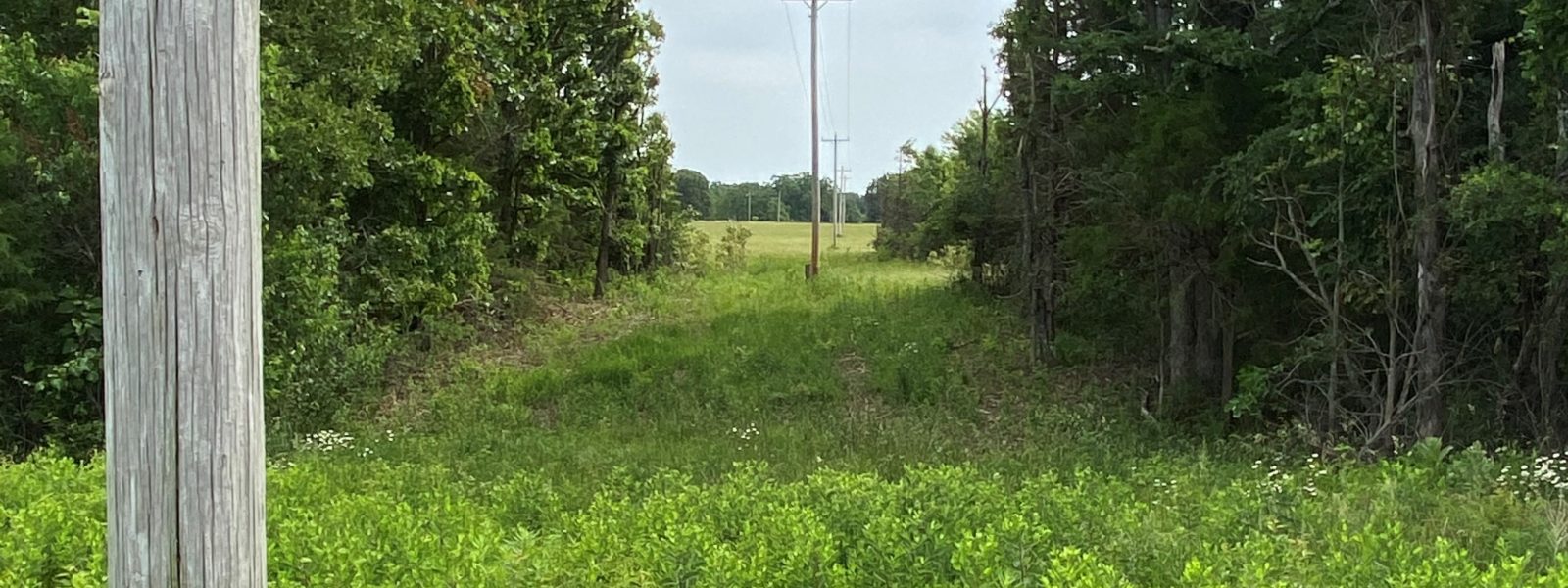
Our Integrated Vegetation Management Program helps balance the need for safe, reliable service by keeping our right-of-ways clear of trees and overgrown vegetation with respect for the natural environment.
Integrated Vegetation Management Program
Tree clearing, pruning, mowing, and herbicide application are necessary steps we take to ensure greater safety for our workers and the public, and to provide more reliable service for our members. We can do this by keeping the power lines free from obstruction. Per Missouri Statute 537.340, any vegetation within 15 feet of the center power line will be removed.
Goals of the program
- Provide electric power to members safely
- Protect the electric system and reduce power outages
- Minimize negative impacts on the environment
- Comply with federal, state, and local regulations
- Work safely and efficiently
- Foster positive working relationships with our communities
WRVEC’s Right-of-Way team is available throughout the process, to respond to any questions or concerns you might have.
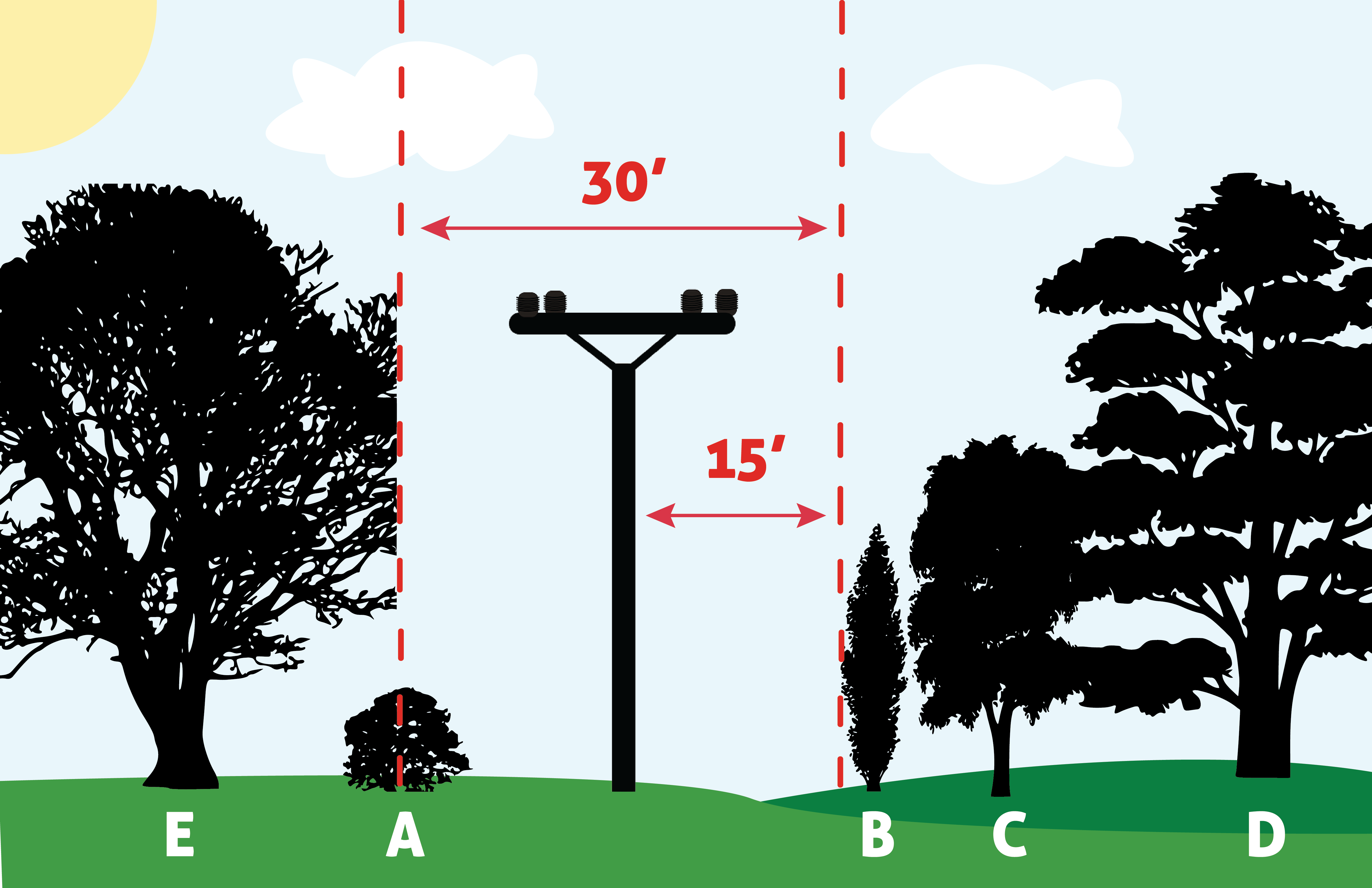
Tips for planting:
A. If landscaping is needed near right-of-way areas or in the wire zone, choose low growth shrubs under 5′ height.
B. Smaller trees should be 20′ away from power lines.
C. Medium trees need to be planted at least 35′ away from lines.
D. Large trees need to be planted at least 45′ away from overhead lines.
E. Trees planted too close to the lines will always be misshapen by unavoidable pruning of limbs to prevent interference with power lines.
2026 Integrated Vegetation Management Projects
The following integrated vegetation management projects are tentatively scheduled for 2026. Please use caution if near these areas. Clearing involves the mechanical and manual cutting, trimming and mowing of vegetation. Herbicide application is used to control the growth of unwanted plants. We thank you for your cooperation while we continue to maintain our electric system.
For integrated vegetation management projects, we contract with the following companies: Southern Construction Inc, APEX ROW, & Red Dirt Arborist.
Only WRVEC and above contractors are approved to work on your property. Any other person or company representative is not an authorized representative of the Cooperative. Please contact your local authorities if you suspect suspicious behavior.
LOCATION |
CONTRACTOR |
Project |
| Cedar Creek – Feeders 2 and 7 | Southern Construction, Inc. | Clearing/Trimming |
| Taneyville | Southern Construction, Inc. | Clearing/Trimming |
| Theodosia | Southern Construction, Inc. | Clearing/Trimming |
| Ava – Feeders 2,3, and 5 | Southern Construction, Inc. | Clearing/Trimming |
| Goodhope | APEX ROW | Herbicide Application |
| Sparta | APEX ROW | Herbicide Application |
| Bear Creek | APEX ROW | Herbicide Application |
| Protem | APEX ROW | Herbicide Application |
| Kimberling City | APEX ROW | Herbicide Application |
| Gretna | APEX ROW | Herbicide Application |
| Lake | APEX ROW | Herbicide Application |
| Blue Water | APEX ROW | Herbicide Application |
| Sweden | APEX ROW | Herbicide Application |
| Gainesville – Feeders 1,3, and 7 | APEX ROW | Herbicide Application |
| Rockaway | APEX ROW | Herbicide Application |
WRVEC's TGR Program
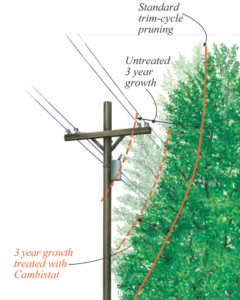
The WRVEC Tree Growth Regulator (TGR) program is a way for us to reduce the amount of pruning needed in targeted parts of the right-of-way throughout the service territory. TGR consists of highly trained TGR experts and applicators identifying and treating specific trees with a growth reduction tool called paclobutrazol. This tool will gently slow the branch growth of the treated tree, promote fibrous root production, and contribute to a healthier and more durable tree overall. Implementing this new tool allows us to treat trees that are in hard-to-access areas where trimming crews might not be able to operate safely. TGR also allows us to more effectively serve members that live in denser populated areas by making sure that the trees trimmed and treated do not grow back at a faster rate than our scheduled trimming cycle. That means if our trim cycle determines that we cut the right-of-way on your property every three years, ideally, we shouldn’t have to come back and cut again before the end of that three-year cycle.
Herbicide Treatment
-
Vegetation can obstruct visibility, interfere with equipment, increase fire risk, and damage infrastructure. Herbicide treatment helps:
- Maintain clear access for maintenance crews
- Improve safety for drivers and workers
- Prevent invasive species from spreading
- Protect utility reliability
-
WRVEC’s herbicide treatment lowers the woody stem count and lowers the time spent on members property doing right-of-way work.
-
Yes. When applied by licensed professionals following strict regulations, herbicides are safe and effective. Applicators follow label instructions, environmental guidelines, and safety protocols to minimize risk to people, pets, and wildlife.
-
Modern herbicide programs are designed to be environmentally responsible. Selective products and precise application methods target unwanted vegetation while preserving desirable plants whenever possible.
-
Areas are evaluated based on vegetation type, density, location, and operational needs. Treatment plans are customized to ensure effective control with minimal impact.
-
WRVEC uses a selective herbicide that is grass friendly and targets the woody stems in the floor of the right-of-way. It is a mix of Vastlan, Terra Vue, Escort, and a liberate nonionic surfactant.
-
Timing depends on vegetation growth cycles and project goals. Applications typically occur during active growing seasons when plants are most responsive. At WRVEC, we typically target the months of June or July for herbicide treatment.
-
Professionals take precautions to prevent drift or off-target impact, including using precise equipment and monitoring weather conditions. The treatment leaves no brownout on the grass.
-
Frequency varies depending on vegetation growth and site conditions. Some areas may require annual treatment, while others may need less frequent maintenance.
-
Yes! Mechanical methods like mowing or cutting are often used in combination with herbicides. WRVEC’s Integrated vegetation management (IVM) plan uses multiple strategies for the best long-term results.
-
The teams arrive in a crew truck. Our herbicide treatment partner is Apex ROW. The applicators are the contractors who walk property lines wearing backpacks that hold the herbicide application mix. The crew members walk the right-of-way easement only, entering through gates. They walk across the property and spray only the trees and areas of the easement.
State Statute
Missouri legislators passed revised statute 537.340 on August 28, 2009. This statute allows electric suppliers the authority to maintain power line right-of-way by trimming, removing and controlling trees and other vegetation within 15 feet of either side of the centerline of electric lines. All potentially energized at or below 34.5 kilovolts, will be removed per the statute. While the bill authorizes a 60 foot removal area, WRVEC chooses to restrain cutting whenever possible to 30 feet. The bill, Senate Bill No. 958, Section 537.340, can be read in its entirety here.